Royal & Toxic
Solomon among the raspberries.
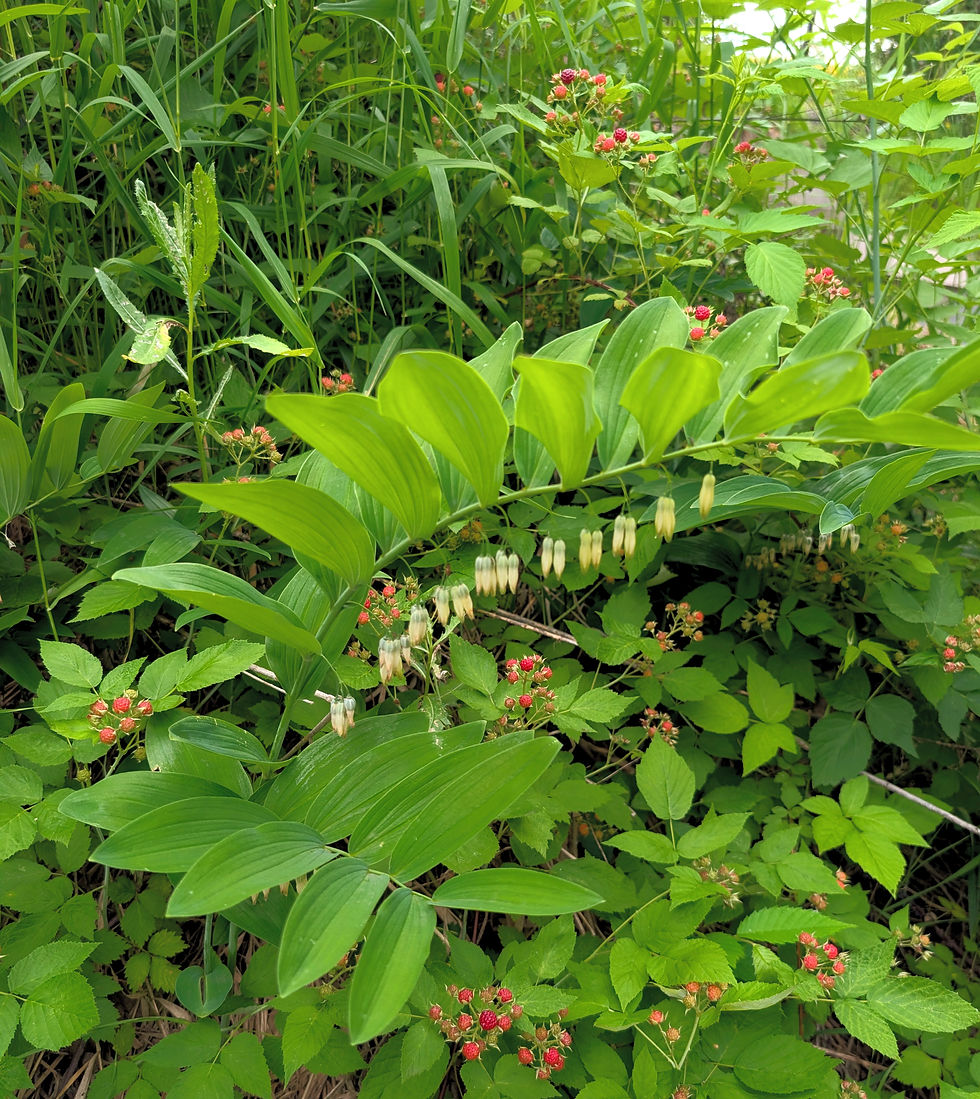
Seems like every day I’m discovering a new branch or tributary off a path in the labyrinth of trails winding through the woods near my townhouse. And just as often there’s something quite surprising! Today it was this graceful arc rising above a scatter of wild raspberries. What a dilemma – do I focus on the frond, or the berries? I picked the frond.
Solomon’s Seal, polygonatum biflorum, has such a promising name origin. But alas, instead of its provenance springing from the wisest man who ever lived on Earth, it comes from the Greek word polygonatum meaning “many knees” referring to the joints on the thick and fleshy rhizome from which the stems are produced. Apparently they are supposed to look like a royal seal.
"You were the gardener; I was the maid And I regret that we were laid Down in the dell where a single spray Hung with bellflowers crossed our way, But earth and loam did not reveal The roots were marked with Solomon’s Seal."
Giles Watson
A close relative to the lowly asparagus and the lovely lily of the valley, Solomon’s Seal is both spectacular and underutilized in the domestic gardener’s palette. Something like a fern in shape and structure with bell-shaped pendant flowers, attractive Solomon’s Seal is not too fussy about habitat, preferring light, well-aerated soil and dappled sunlight – but here’s the dealbreaker – it’s poisonous. Although thought by early herbalists to be beneficial as a skin balm or poultice, if ingested in any form it will not go well with you.
So, for visual appeal, go ahead and put them in with your hostas, but don’t get creative with tinctures and teas. And keep your dogs and cats away too.


Comments